
Executive take-away
Insurance is not shrinking. The work is moving.
That is the simplest way to understand what AI is doing to insurance. Claims are being read faster. Underwriting files are being sorted faster. Customer queries are being answered faster. The pressure is not on insurance itself. The pressure is on routine insurance work.
For the GCC, this matters now. AI is already being used in claims, underwriting support, fraud screening, and customer servicing. The real issue is no longer whether the market will adopt AI. It is whether insurers can retrain people, redesign entry-level roles, and build the governance needed to scale it safely.[1][2][3]
This article focuses on five practical questions: where AI is already being used, which roles are under pressure, which roles are being transformed, what new roles are emerging, and what GCC insurers should do next.
1. AI has moved from pilot to practice
AI in insurance is no longer a side project. A Deloitte survey found that 76% of US insurance executives had already built generative AI into at least one part of their operations. Yet only a small minority have scaled it across the enterprise, with research suggesting that just 7% have moved beyond the test stage. The main bottleneck is not software. It is talent, governance, and operating readiness.[3][4]
The strongest live use cases are now well established:
- Claims handling: AI can review documents, check coverage, flag missing information, screen for fraud, and suggest next steps before a human signs off.[5][6]
- Underwriting support: AI can extract submission data, compare it against rules, and prepare files so underwriters spend more time on judgement and less on desk work.[7][8]
- Customer service: AI agents can handle routine queries across email, chat, and portals, then escalate complex matters to a human.[8][9]
The GCC market for AI-powered insurtech was valued at about USD 2.5 billion in 2025. Adoption in the region is real, but still uneven. Much of the current activity remains focused on document extraction, risk scoring, automated claims steps, and digital customer journeys rather than fully scaled end-to-end AI operating models.[10][11][12]
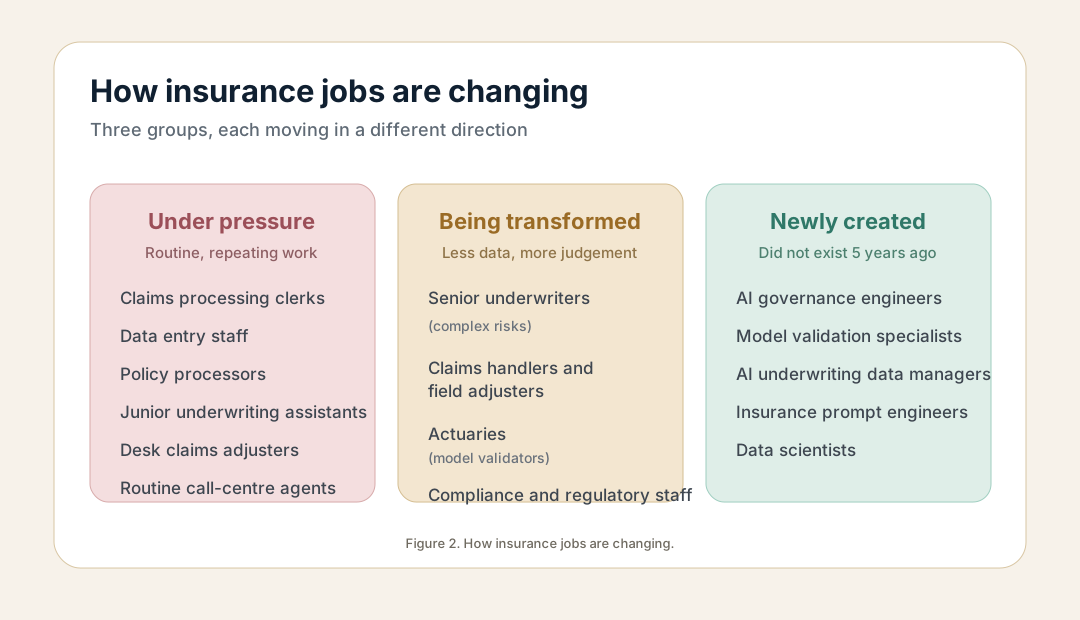
2. The first jobs under pressure are the routine ones
AI is not creating one sudden wave of layoffs. It is steadily removing the need for repetitive work. BCG estimates that 50% to 55% of jobs may be significantly reshaped by AI over the next two to three years, while 10% to 15% may face full replacement over five years.[13][14]
In insurance, the signal already shows up in labour-market data. The Jacobson Group and Aon reported that US finance and insurance job openings fell from an average of 281,000 a month to about 138,000 in December 2025, the lowest point in a decade.[15]
- Claims clerks and policy processors: routine cover checks and paperwork are highly automatable.[15]
- Data-entry and administrative staff: AI is faster at extracting, validating, and moving information between systems.[15]
- Junior underwriting support roles: standard submissions and rule-based referrals can increasingly be pre-processed by AI.[16]
- Desk-based claims adjusters: high-volume, low-complexity files are ideal for automation.[16]
- Routine call-centre roles: FAQs and simple service requests are already mature AI use cases.[15]
The deeper risk for insurance is not only job loss. It is the erosion of the traditional entry-level path. Many of the roles being squeezed are the same roles where future underwriters, claims specialists, and account managers used to learn the trade. If those jobs disappear without a replacement learning model, the industry risks becoming top-heavy and under-trained.[19]
3. The GCC talent gap is becoming a strategic risk
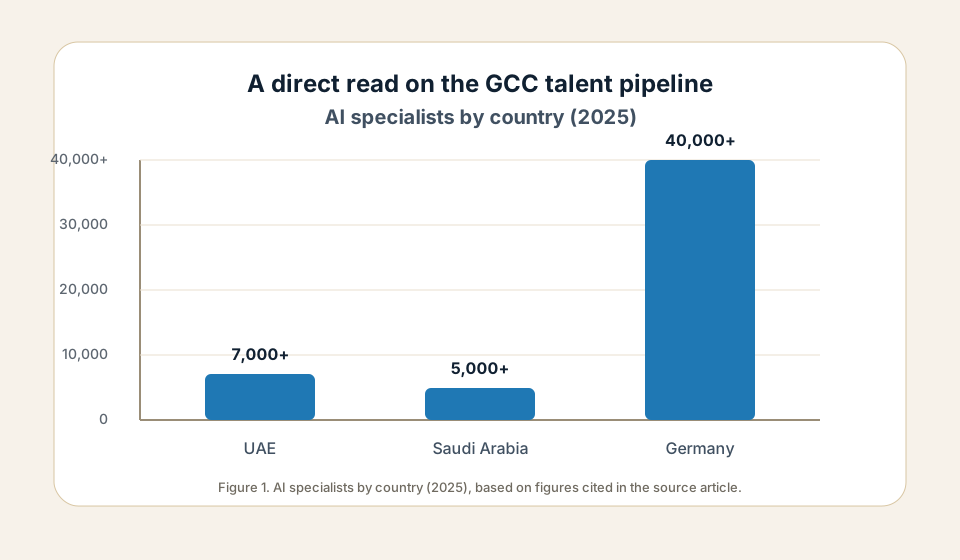
The GCC has strong AI ambition, but the talent pipeline remains thin. BCG’s 2025 GCC AI Pulse estimated about 7,000 AI specialists in the UAE and about 5,000 in Saudi Arabia, versus more than 40,000 in Germany, despite a similar economic scale.[2]
This talent shortage is especially important in insurance because firms need more than generic coders. They need people who understand both insurance and AI: underwriting logic, claims practice, data quality, model risk, and governance. Regional research has identified this “war for insurance tech talent” as one of the major strategic constraints on GCC insurers.[1]
Put simply, the region can buy technology faster than it can build the people needed to use that technology well.
4. Many insurance roles are not disappearing — they are being rewritten
The most valuable insurance jobs are becoming less about data gathering and more about judgement.
- Underwriters will spend less time collecting and sorting information, and more time on complex risks, exceptions, pricing judgement, and client discussions.[20][21]
- Claims handlers and adjusters will spend less time on intake and routine checking, and more time on disputed files, fraud, negotiation, empathy, and large losses.[16][20]
- Actuaries will increasingly act as model reviewers and validators, ensuring AI-driven pricing and reserving outputs remain accurate, fair, and explainable.[19][20]
- Compliance and regulatory teams will need to understand both insurance rules and how AI systems behave in practice.[19][22]
PwC’s 2025 Global AI Jobs Barometer found that skills in AI-exposed roles are evolving 66% faster than in roles less touched by AI. That means standing still is no longer safe, even for technically trained professionals.[19]
5. New roles are already emerging
As routine work is automated, new roles are appearing across the insurance value chain. These include:
- AI governance engineers, who translate legal, ethical, and control requirements into real model governance frameworks.[22][23]
- Model validation and AI oversight specialists, who test whether underwriting, claims, pricing, and fraud models remain reliable and fair.[24]
- AI underwriting data managers, who bridge business teams and AI teams while managing data quality and external data inputs.[25]
- Insurance data scientists, who work on pricing, claims prediction, reserving, and underwriting analytics.[24]
- Insurance prompt and workflow specialists, who design and test how large language models behave inside real insurance processes.[26][27][28]
6. What GCC insurers should do now
- Retrain from within: it is often faster to teach AI literacy to experienced insurance professionals than to teach insurance judgment to pure technologists.[3][29]
- Rebuild the junior career path: use rotations, simulations, supervised reviews, and AI-assisted learning in place of repetitive apprenticeship work.[4][19]
- Make AI literacy a core skill: underwriters, claims managers, actuaries, and compliance teams should all know how to read, question, and escalate AI outputs.[19]
- Build governance before scale: explainability, accountability, and model-risk controls should be in place before AI expands deeper into pricing, claims, and fraud workflows.[19][22]
- Use AI to capture institutional knowledge: as experienced professionals retire, AI can help preserve how senior staff assess claims, judge risks, and make decisions.[3][19]
Conclusion
AI will not remove the need for insurance expertise. It will increase the value of the expertise that machines do not easily replace: judgement, accountability, communication, and risk understanding.
For the GCC, the winners will not be the firms that merely buy AI tools. They will be the firms that combine insurance judgement, strong data, and responsible AI governance — and that move early enough to prepare their people for the shift.
References
- Navigating digital transformation in the GCC insurance sector — Roland Berger — Six strategic clusters of digital transformation in GCC insurance.
- GCC AI Pulse: Mapping Readiness for AI-Driven Future — BCG — Inaugural assessment of AI development across the six GCC nations.
- AI Talent Crisis in Insurance — insuranceindustry.ai — Insurance executives are making a $50-70bn bet on AI while starving it of talent.
- What The Insurance Industry Is Getting Right About AI But Not About People — Forbes — 76% of insurers have deployed AI but half the workforce wants out.
- Allianz launched its first agentic AI to automate claims — Allianz — Project Nemo, launched in Australia in July 2025, uses AI agents on low-complexity claims.
- How Allianz Partners are transforming the claims experience — DeepOpinion — Pieter Viljoen on Agentic Process Automation in Allianz Partners’ claims.
- Transforming Insurance with AI-Powered Autonomous Agents — Microsoft — Use cases for AI agents across the insurance value chain.
- Agentic AI adoption in insurance: scaling efficiency and operations — Microsoft — Microsoft and Cognizant on scaling AI for claims modernisation.
- Shedding Light on Agentic AI in Insurance — Celent — Insurers’ growing comfort with delegating tasks to specialised AI agents.
- GCC AI-Powered InsurTech Platforms Market — Ken Research — GCC AI-powered insurtech market valued at USD 2.5bn.
- The AI Hype in UAE and GCC Medical Insurance — LinkedIn — Predictive analytics and risk assessment in GCC medical insurance.
- Digitalisation in insurance: a golden opportunity for GCC insurers — Kearney — Union Insurance Company UAE on AI and NLP in motor policy issuance.
- AI Will Reshape More Jobs Than It Replaces — BCG — 50-55% of US jobs reshaped by AI over the next 2-3 years.
- AI Will Reshape More Jobs Than It Replaces — BCG Henderson Institute — Companion piece to BCG main report.
- AI is coming for insurance professionals — Insurance Business — Q1 2026 Jacobson/Aon Labor Market Study highlights.
- The Top Insurance Jobs of 2026 — Dahl Consulting — BLS projections on underwriting and claims adjuster roles to 2034.
- Is AI closing the door on entry-level job opportunities? — WEF — 40% of employers expect to reduce workforce where AI can automate.
- The Future of Jobs Report 2025 — WEF — Input from over 1,000 leading global employers.
- AI and the insurance workforce: Enabling the human-AI organization — PwC — PwC’s framework for the AI insurance workforce transition.
- AI’s Impact on Traditional Insurance Jobs — Insurance Thought Leadership — How AI is transforming traditional roles in the industry.
- The Role of Artificial Intelligence in Insurance Underwriting — Crankwheel — AI as a data assembly and risk classification assistant for underwriters.
- AI Governance Engineer — Swiss Re — Swiss Re job specification for the AI Governance Engineer role.
- AI Governance Engineer — Swiss Re Corporate Solutions — Corporate Solutions listing for the AI Governance Engineer role.
- AI Underwriting Jobs — Indeed — Over 2,000 AI underwriting roles listed in the US market.
- AI Underwriting Data Manager — Next Insurance — Bridging AI/ML teams and underwriting operations.
- AI Prompt Engineer — Insurance / Underwriting — LinkedIn — Remote contract role specification.
- AI Prompt Engineer — Insurance Underwriting — Dice / SANS — 12-month remote AI prompt engineer placement.
- Sr. Prompt Engineer — Assured Insurance Technologies — Assured Insurance Technologies senior prompt engineer role.
- AI Reskilling in the Insurance Industry — insuranceindustry.ai — On the gap between AI investment and workforce reskilling.
- AI to reshape jobs more than replace them — FOX 5 New York — BCG report on AI reshaping over half of US jobs.
- Future of Jobs Report 2026: 92M Jobs Lost & 170M Created — College Vidya — Net global gain of 78 million jobs from AI by 2030.