
When I look at multinational insurance programmes, most of the discussion naturally starts with coverage. Is there a local policy? Does the master policy provide Difference in Conditions or Difference in Limits? Are the limits adequate? Those are important questions, but the more I have looked at these programmes from a practical claims perspective, the more I have felt that there is another question that deserves equal attention: if a large loss occurs outside the master policy country, where can the claim money actually be paid?
Consider a group headquartered in the UAE. The parent company has operating subsidiaries in India, Brazil and several other countries. The group wants consistent Commercial General Liability protection across all of its operations. It may appear easier to buy one large CGL policy in the UAE and extend it worldwide. In practice, multinational insurance rarely works that simply because insurance regulation remains local even when the business is global.
Why the group still needs local policies
An admitted insurer is an insurer that is licensed or otherwise authorised to write the relevant insurance in that jurisdiction. A non-admitted insurer is not locally licensed for that insurance transaction. The exact rules are different from country to country, and the restrictions may depend on the class of insurance, the location of risk, the insured entity and even the activities carried out by the foreign insurer.
India and Brazil are useful examples because both have strong local insurance frameworks, although their legal rules are not identical. India restricts the carrying on of insurance business without the required Indian registration and contains specific restrictions on insurance of certain Indian risks with foreign insurers. Brazil generally requires insurance for risks in Brazil to be contracted in Brazil, subject to statutory exceptions. This is why a multinational group will often arrange locally admitted policies rather than assuming that the home-country insurer can simply cover every overseas entity directly.
There is one point I would clarify because it is easy to oversimplify this subject. A locally admitted policy does not necessarily mean that all of the economic risk or all premium must remain inside that country. Subject to local regulation, the local insurer may use reinsurance and may cede part of the risk outside the country. The regulatory focus is usually on ensuring that the local insurance transaction - policy issuance, premium, taxes and levies, regulatory reporting and local servicing - is handled in the permitted manner.
How the master programme fits around the local policies
Let us assume the UAE parent buys a master CGL policy with a USD 100 million limit. The Indian and Brazilian subsidiaries each have locally admitted CGL policies with a USD 5 million limit. The numbers are only illustrative, but this is the familiar controlled master programme structure used by many multinational companies.
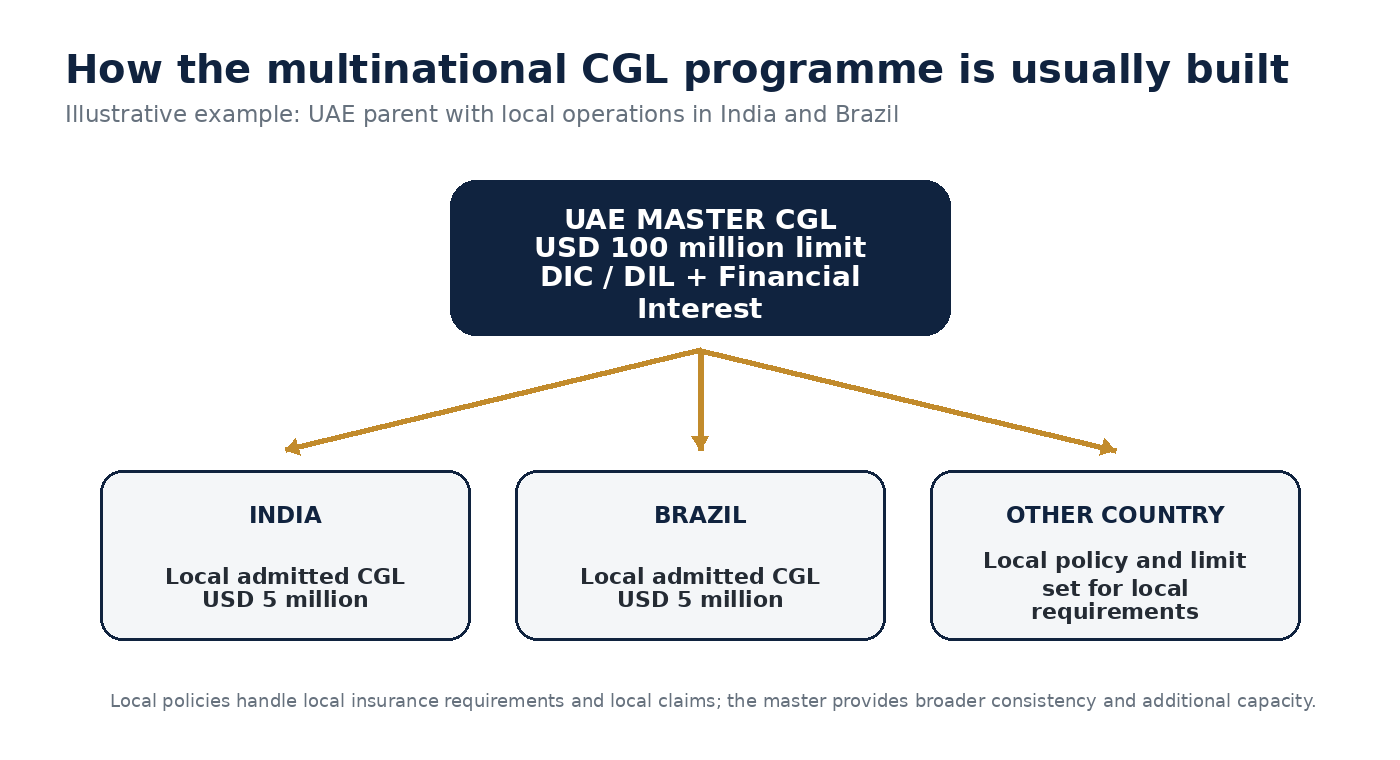
The local policies give the subsidiaries locally recognised insurance and a local claims mechanism. The UAE master policy then sits above the programme to provide broader consistency and additional capacity. This is where DIC and DIL are normally discussed.
Difference in Conditions, or DIC, is intended to address a situation where the local policy provides narrower coverage than the master policy. If a loss is not covered, or is only partly covered, under the local wording but would be covered under the master wording, the master may respond to the difference, subject to its terms, exclusions and the applicable legal structure.
Difference in Limits, or DIL, deals with the amount of insurance available. If the local policy provides USD 5 million and the covered loss is substantially higher, the master may provide the additional limit above the local policy. Multinational insurers commonly describe master policies with DIC/DIL sitting above locally admitted policies as part of a coordinated global programme.
On paper, this is a very good solution. But DIC and DIL answer the coverage and limit question. They do not automatically answer the payment question.
The claim that works exactly as expected
Suppose a liability claim occurs against the Indian subsidiary and the final settlement is USD 3 million. The Indian admitted CGL policy has a USD 5 million limit. The local insurer investigates the loss, adjusts the claim and settles the USD 3 million in India. The master policy is not required. The loss, the insured, the policy and the claim payment are all in the same jurisdiction. There is very little to debate from a programme-structure perspective.
This is also why the settlement problem can remain invisible for years. If most claims stay within the local policy limits, the programme can appear to work perfectly.
Then the same subsidiary has a much larger loss
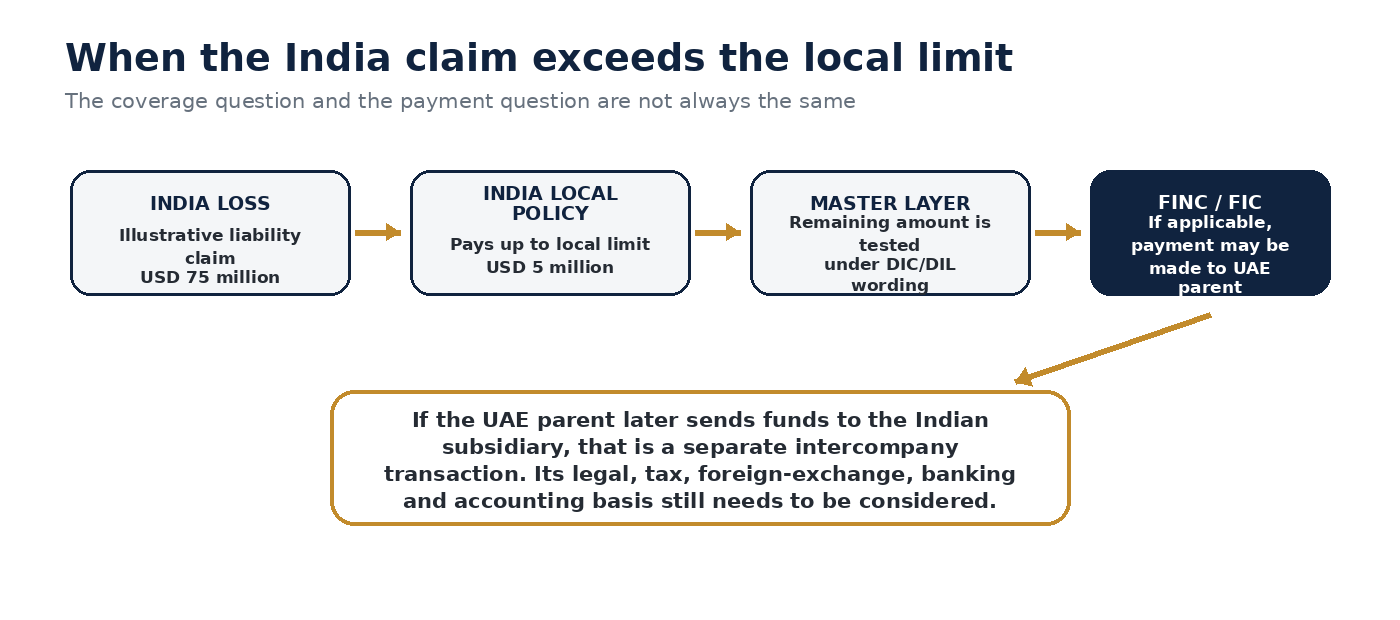
Now assume the Indian subsidiary faces a USD 75 million liability claim. The local policy still has a USD 5 million limit. The Indian insurer can deal with its local layer, but the remaining amount now has to be considered under the UAE master policy.
From a DIL perspective, the analysis may look straightforward. If the loss is covered and the master has sufficient limit, the excess amount may fall within the master layer. That does not necessarily mean the UAE master insurer can simply transfer the excess claim amount to the Indian subsidiary and describe the payment as a claim settlement.
The reason is that, in some jurisdictions, regulation of non-admitted insurance goes beyond the question of where the policy was issued. Activities such as claim payment, loss adjustment, premium invoicing or risk engineering can themselves be treated as regulated insurance activity. Zurich has specifically highlighted this point in its multinational guidance. The result is that the correct answer to ‘can the master insurer pay the local subsidiary directly?’ is not a universal yes or no. It depends on the law and the permitted claims route in that particular country.
Why the parent cannot simply treat it as an ordinary transfer
A natural response is to say: if the UAE insurer cannot pay the Indian subsidiary directly, let the insurer pay the UAE parent and let the parent send the money to India. Commercially, that sounds simple. Once the money moves from the parent to the subsidiary, however, the second payment is no longer merely an insurer settling a claim. It becomes an intercompany transaction and needs its own explanation.
The finance team may have to determine whether the amount is a capital contribution, an intercompany loan, a reimbursement of expenditure, a payment made on behalf of the subsidiary or some other form of group support. That classification can affect the accounting entries in both entities, related-party disclosures, corporate approvals and the documents that the auditor expects to see.
Tax questions can follow the same classification. A capital contribution is not treated in the same way as a loan. A loan may create interest, transfer-pricing and other tax considerations. A reimbursement or recharge may have a different tax treatment again. Cross-border related-party transactions can also require transfer-pricing support, and financial transactions such as intercompany loans are specifically addressed in international transfer-pricing guidance.
There can also be foreign-exchange and banking formalities. For a large international transfer, a bank may ask for the purpose of payment, the supporting agreement, the source of funds and the basis on which the receiving entity is entitled to the money. That does not mean a large transfer is automatically prohibited or suspicious. It means the legal explanation, accounting treatment and payment documentation need to tell the same story.
This is where a programme that looked very clean on the insurance schedule can become uncomfortable at claim stage. The coverage may exist. The insured group may have USD 100 million of master capacity. Yet the local company facing the liability may not have a simple route to receive the excess cash when it needs it.
Where Financial Interest comes into the programme
Financial Interest coverage is one of the mechanisms designed for this situation. Depending on the insurer, it may be described as Financial Interest Coverage, a Financial Interest Clause, FINC, FIC or FI coverage. The wording is important because the concept is different from simply naming the foreign subsidiary as an insured under the master policy.
In broad terms, the master policy protects the parent company’s defined financial interest in a foreign subsidiary. Where a loss occurs in a country in which the master insurer cannot, or should not, directly insure or pay the local entity on a non-admitted basis, the master can - if the Financial Interest wording is triggered - indemnify the parent in the country where the master policy was issued for the parent’s defined financial interest loss.
Chubb explains Financial Interest in this way in its multinational guidance and specifically discusses India and Brazil as examples of jurisdictions where non-admitted insurance restrictions can make FI coverage relevant. AIG’s 2026 multinational legal material similarly treats Financial Interest Clauses, DIC/DIL, non-admitted insurance, tax considerations and cross-border claims as related but distinct parts of programme design.
Returning to the India example, the local insurer may pay its USD 5 million limit. The balance is then tested under the master policy. If DIL coverage and the Financial Interest wording apply, the UAE master insurer may pay the UAE parent for the parent’s defined financial interest loss, up to the amount determined under the actual wording and applicable limits. I would not automatically assume that the Financial Interest valuation will always equal the subsidiary’s remaining liability; that depends on how the clause measures the parent’s loss.
FINC helps, but it does not finish the job
At this point, the insurer may have done exactly what the master policy was designed to do. The payment has been made to the master-policy insured in the UAE rather than directly into a jurisdiction where non-admitted claim activity could create a problem.
But the underlying Indian subsidiary may still have to pay a claimant, replenish cash already used for the settlement or repair the financial impact of the loss. If the parent now has to fund the subsidiary, the group is back to the intercompany questions discussed above. FINC can solve, or at least improve, the master insurer’s permitted payment route. It does not automatically solve the downstream corporate funding route.
This distinction matters particularly when local policies are purchased with very small limits simply to satisfy a local-admitted requirement. A nominal local policy may be inexpensive at inception, but it can leave a large amount of a severe claim dependent on DIL and Financial Interest at exactly the time the local operation needs liquidity.
How I would look at the programme before placement
I do not think the answer is to abandon the master-policy structure or to duplicate the full global limit in every country. That would often be uneconomic and unnecessary. The better approach is to decide the local limit with the actual exposure and the claim-payment route in mind, rather than treating the local policy as a compliance document only.
For a lower-hazard operation, a USD 1 million or USD 5 million local limit may be entirely reasonable. For another subsidiary with significant products exposure, contractual liability or the potential for severe third-party injury or property damage, that same limit may leave too much dependence on the master. The broker, insurer and risk manager should therefore consider realistic local claim severity, contractual requirements, compulsory limits, local market capacity, the cost of additional local limit and the amount of excess loss that the group could comfortably fund through the master structure.
Where appropriate and legally permitted, a meaningful locally admitted limit can also be supported by reinsurance. In other words, the local insurer can issue the policy and retain or cede the risk through the permitted reinsurance structure. That can sometimes give the client a more usable local claims limit without requiring the local insurer to retain the entire exposure on its own balance sheet. The economics, premium taxes, fronting costs and local reinsurance rules still need to be considered country by country.
I would also want a basic claim-payment map for the important countries before the programme is bound. If the local limit is exhausted, who adjusts the excess claim? Can the master insurer pay the local entity, the claimant or only the parent? If payment goes to the parent, how will the subsidiary be funded? What supporting documents will treasury, the bank, tax and audit teams need? These are not questions that need a fifty-page legal memorandum for every country, but the material jurisdictions should have a clear and agreed route.
The same applies to the wording. DIC/DIL clauses, Financial Interest provisions, named-insured language, valuation of financial interest, conformance-to-law wording, territorial provisions, tax clauses and claims-control requirements all need to be read together. A master programme should be reviewed not only as a document that provides coverage, but also as a structure that has to deliver a workable claim payment when the local policy is no longer enough.
My conclusion
For me, this is the part of multinational insurance that deserves more discussion during placement. We spend a lot of time comparing master limits and local policy wordings, and rightly so. But a severe multinational claim also tests the payment route, the local regulatory position and the group’s own ability to move funds between its entities.
DIC, DIL and Financial Interest are valuable tools, but none of them should be looked at in isolation. A sensible local limit, a clear master-policy response and a pre-considered funding route work much better together than trying to solve the payment mechanics after a major claim has already occurred.
That is why, when I review a multinational liability programme, I would want to understand not only whether the excess loss is covered, but what happens next if the local policy limit is exhausted. It is a relatively small discussion to have before inception, and a much more difficult one to have while a large liability claim is waiting to be paid.
Sources and further reading
India Code: Insurance Act, 1938 - Sections 2C / 2CB and registration framework - source
Brazil Presidency: Complementary Law No. 126/2007 - Articles 19 and 20 - source
Allianz Commercial: Multinational Insurance Solutions - master policy with DIC/DIL above local policies - source
Zurich: The Importance of Context - non-admitted insurance and regulated claims activities - source
Chubb: Helping Multinational Clients Navigate the Nuances of Master Policy DIC/DIL Clauses - source
AIG: AIG Multinational Legal Summary Sheet (2026) - source
OECD: Transfer Pricing Guidelines for Multinational Enterprises and Tax Administrations - source