
Executive take-away
In cross-border disputes, losses are seldom traceable to a single defective clause. The more frequent cause is misalignment between the contract that was negotiated, the forum that was chosen, the jurisdiction where the assets sit, and the territorial reach of the policy expected to respond.
Why this question matters before a claim exists
A contract may be negotiated in London, performed in Dubai, serviced from Mumbai, and disputed across more than one jurisdiction at the same time. On paper it reads as a single commercial relationship. Under pressure it becomes a contest between legal systems, procedural rules, asset locations and policy wording.
For insurance professionals, that contest carries practical consequences. It shapes claim notification, reservations of rights, defence strategy, settlement leverage, and whether the insured has a realistic route to recovery. The relevant enquiry at placement is therefore broader than which court the contract names; it extends to whether the entire structure still functions when a dispute crystallises.
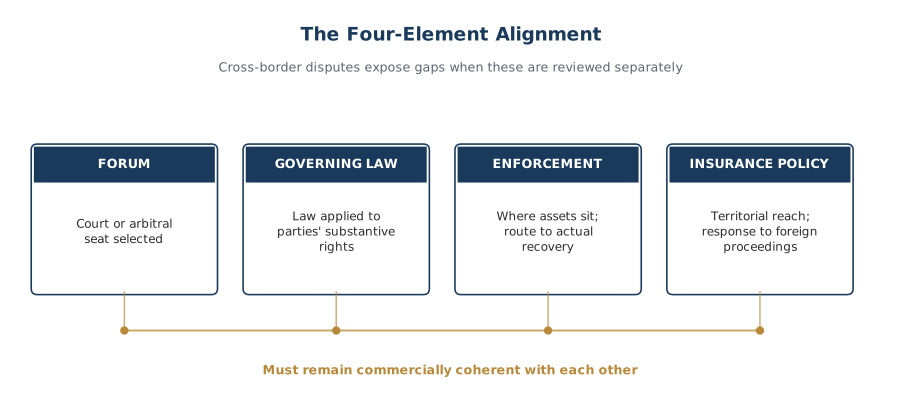
Four elements need to be considered together: the court or tribunal selected, the law governing the substance of the dispute, the place where any judgment or award must be enforced, and the insurance policy expected to respond. When those elements are reviewed separately, or only at the contracting stage, a subsequent dispute will frequently expose gaps that were not visible at signing.
Three questions, kept separate
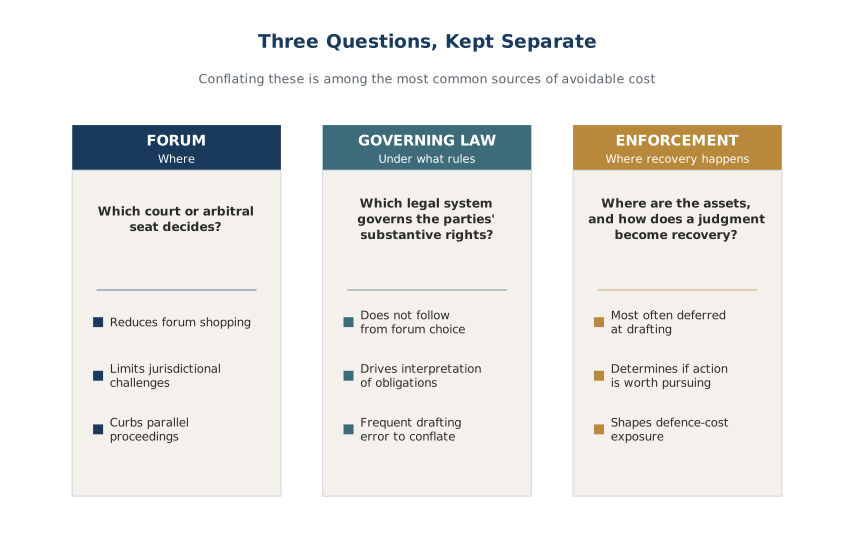
Three questions should be addressed in any cross-border contract, and addressed separately. Conflating them is among the more common sources of avoidable cost and procedural friction.
Forum. Which court, or which arbitral seat, is intended to determine the dispute? A precise forum clause reduces exposure to forum shopping, jurisdictional challenges and parallel proceedings.
Governing law. Which legal system governs the parties’ substantive rights and obligations? Governing law does not follow automatically from the choice of forum. Treating the two as equivalent is a frequent and costly drafting error.
Enforcement. Where are the counterparty’s assets located, and through what process will a judgment or arbitral award be converted into actual recovery? This is the question most often deferred at the drafting stage, and frequently the one that determines whether the proceedings were commercially worth pursuing.
A judgment obtained in a jurisdiction where the counterparty holds no recoverable assets has limited commercial value. For defendants and their insurers, the practical question is which jurisdictions could foreseeably see proceedings, and where the resulting defence costs will be incurred.
DIFC Courts: useful when the use is real
The DIFC Courts continue to attract international commercial users for understandable reasons. They operate in English, apply a common-law procedural framework, and sit within Dubai’s broader legal architecture. For multinational businesses and their advisers, that combination offers procedural familiarity, specialist commercial handling, and a forum more easily navigated than an unfamiliar local court system.
A DIFC clause should not be inserted as a prestige label by default. It is genuinely useful only where it supports the intended enforcement strategy, fits the counterparty profile, and aligns with the insurance programme expected to respond. The same discipline applies to any preferred forum: the relevant test is whether the choice does commercial work, not whether the name is familiar.
The UAE is not one dispute environment
References to “UAE law” are often made loosely. For dispute-planning purposes, that shorthand obscures distinctions that matter. Onshore UAE courts, the DIFC Courts and the ADGM Courts each operate within different legal traditions, different procedural expectations, and different drafting conventions. Treating them as interchangeable within a contract clause is a frequent source of disputes ending up in an unintended venue.
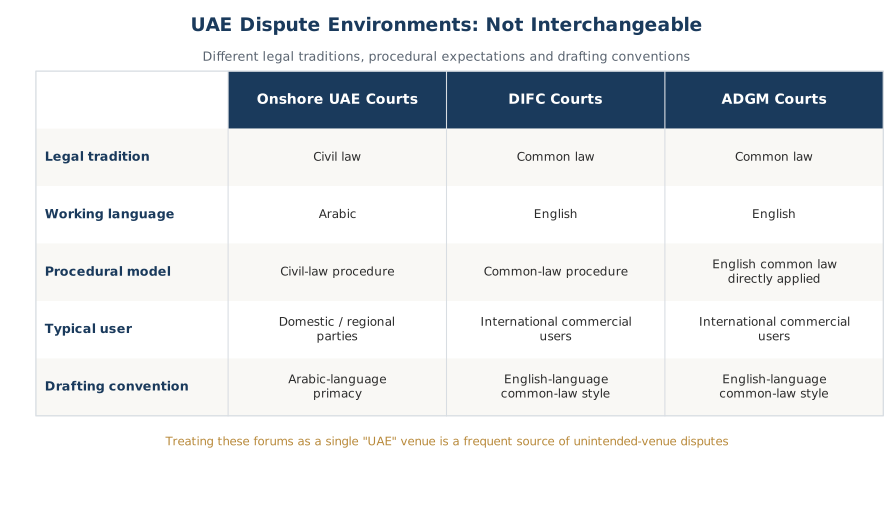
The distinction is particularly relevant for groups contracting across multiple jurisdictions, servicing clients from different UAE bases, or purchasing liability cover expected to respond to claims filed in more than one of these forums. A policy that appears adequate for domestic operations may prove narrow once the claim path becomes international.
Where coverage actually breaks
Cross-border coverage problems are usually a product of misalignment rather than of any single dramatic exclusion. The contract points one way, the claim is filed another way, and the policy was written for a narrower territorial footprint than the dispute now requires.
On Commercial General Liability, the predictable stress points are territorial scope, the treatment of foreign proceedings, defence-cost handling, and the breadth of the policy’s definition of “claim”. On Professional Indemnity, the focus shifts to claims-made timing, retroactive dates, notification mechanics, the geography in which services were actually performed, the treatment of foreign-law liability standards, and whether the policy realistically contemplates the forums in which clients could bring proceedings.
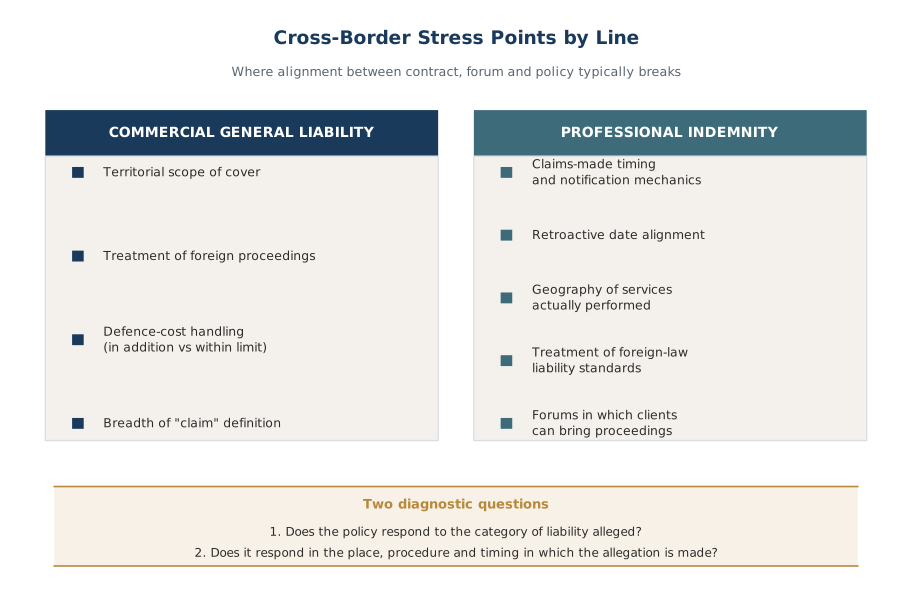
Two questions, taken in sequence, will identify most of the alignment risk in a programme. Does the policy respond to the category of liability being alleged? And does it respond in the place, procedure and timing in which the allegation is actually being made?
A short checklist before placement or renewal
Before a material cross-border contract is signed or a programme is renewed, the contract and the policy should be examined together. Six review points are worth running through in sequence.
| Review point | Question to ask | Why it matters |
|---|---|---|
| Governing law | Is the substantive law stated, and does it actually suit the deal? | Drives the liability standard the defence has to argue against. |
| Forum clause | Is it exclusive, non-exclusive, or arbitral — and consistent with the rest of the contract? | Decides where the spend lands and who picks counsel. |
| Asset location | If a judgment or award is issued, where will it have to be enforced? | Tells you whether the legal spend produces recovery or paper. |
| Policy territory | Does the cover match where services are delivered, clients sit, and claims can be brought? | The most common source of false comfort at placement. |
| Definition of claim | Are foreign proceedings, investigations and pre-action demands treated as claims? | Controls when notification has to go in, and how clean the trigger is. |
| Disclosure | Have the cross-border activities and the contract templates actually been shown to the brokers and insurers? | Information not disclosed at placement tends to surface at renewal, and occasionally at the point of claim. |
Closing thought
The most effective risk architecture is usually not the most elaborate. It is one in which the contract, the chosen forum, the governing law, the enforcement route and the insurance programme are commercially coherent with each other.
That alignment is best tested before any dispute exists. Once proceedings are underway, parties commonly find that jurisdiction and coverage are not procedural footnotes; they are the structural framework that determines whether a legal entitlement converts into actual recovery.
Selected official references
Institutional descriptions in this note are drawn from the following public sources, last checked 19 May 2026.
- DIFC Courts — jurisdiction and FAQs on the English-language common-law commercial forum: Courts FAQ and Jurisdiction
- ADGM Courts — official materials on the direct application of English common law within ADGM: ADGM Courts and English common law
- UAE Government portal — federal judiciary overview: Federal judiciary
Disclaimer
This note is general information and professional discussion only. It is not legal, insurance, broking or risk-management advice. Specific matters should be reviewed with qualified counsel and brokers.